Acting locally, for global impact: marking International Day for Biological Diversity at the Nairobi Safari Walk

Participants at the Nairobi Safari Walk after the marking of the International Day for Biological Diversity 2026.
On 22 May 2026, Nature for Health (N4H) joined UNEP's Biodiversity and Land Unit, the Kenya Wildlife Service and partners across government, conservation, health and development to explore what biodiversity action looks like when it is also pandemic prevention.
NAIROBI, 22 May 2026: On a bright morning at the Nairobi Safari Walk, partners from across Kenya's government, conservation, health and development sectors gathered under the canopy of indigenous trees to mark the International Day for Biological Diversity 2026, under this year's UN theme Acting locally for global impact.
The gathering, convened by UNEP's Biodiversity and Land Unit with the Kenya Wildlife Service (KWS), focused on a more specific question: what does it look like, in practice, when biodiversity action protects not only ecosystems and species, but human health? For the Nature for Health (N4H) initiative, which is supporting Kenya as one of six Phase I countries to advance upstream pandemic prevention, the question is at the centre of our work.
Welcome to the work
Anastacia Mwaura of the Kenya Wildlife Service opened the session, welcoming partners to one of Kenya's premier sites for urban-wildlife coexistence, a venue that itself illustrates what the day's theme is reaching for: local stewardship producing global meaning. She thanked partners for convening around a shared agenda and set the tone for a morning that would move quickly across science, governance and community-led practice.
Connecting land to people
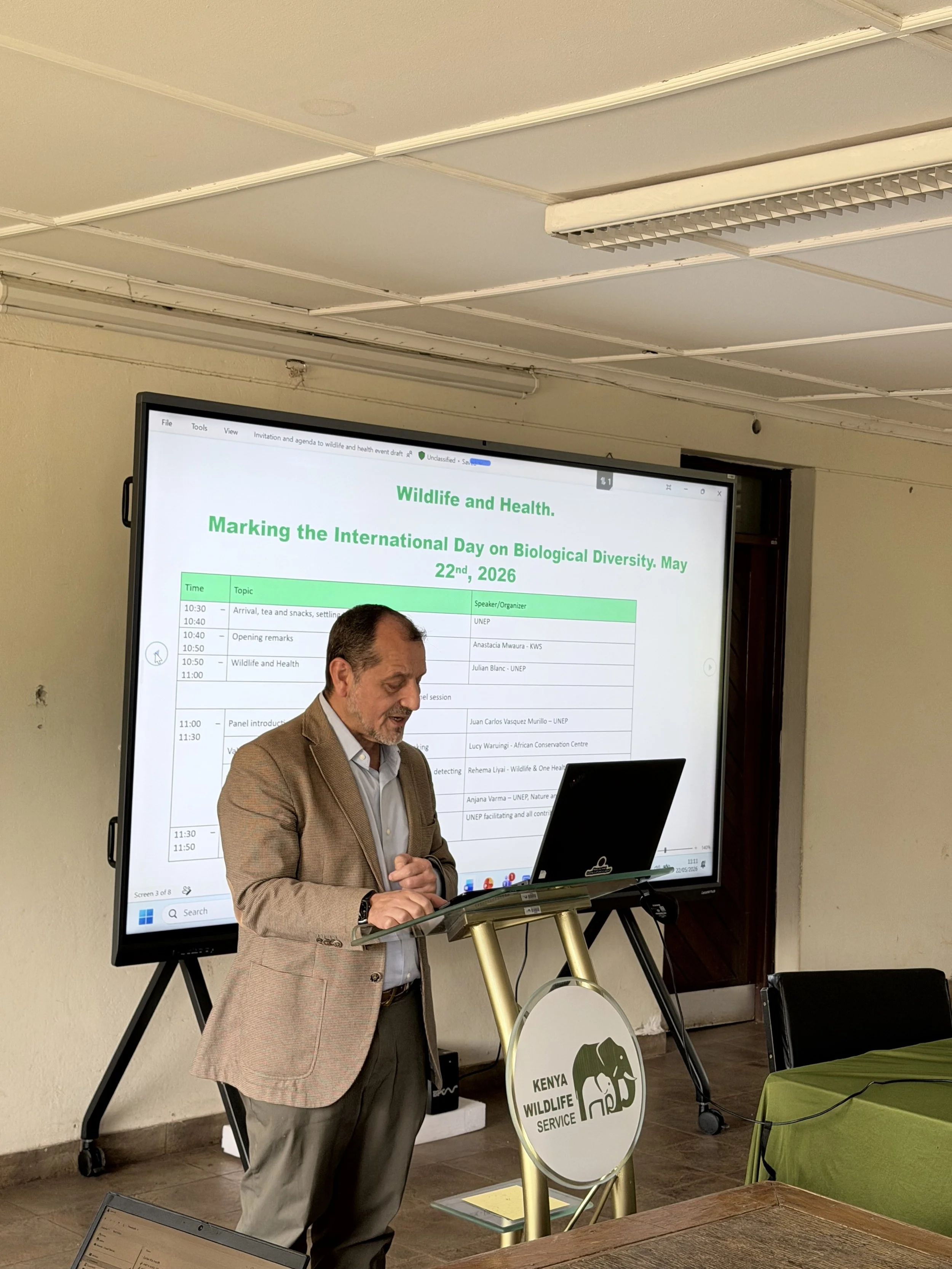
Julian Blanc, Head of UNEP's Biodiversity and Land Unit, delivering opening remarks on Wildlife and Health.
Julian Blanc, Head of UNEP's Biodiversity and Land Unit, anchored the conversation in a single line that did much of the day's work:
“Connecting the health of our land capital to the health of our people.”
Biodiversity loss, ecosystem degradation, and the fraying of the natural systems on which humans depend, he argued, are not only conservation problems. They are health problems, livelihood problems, and ultimately, governance problems. Treating them as separate is a category error the planet can no longer afford.
He returned, too, to the day's theme. Acting locally for global impact is exactly what KWS does; he noted its work to safeguard Kenyan wildlife and ecosystems ripples outwards far beyond the country's borders. And the broader frameworks the international community has committed to, the Kunming-Montreal Global Biodiversity Framework chief among them, “mean nothing without implementation.” That, he said, is the work.
Setting the scene
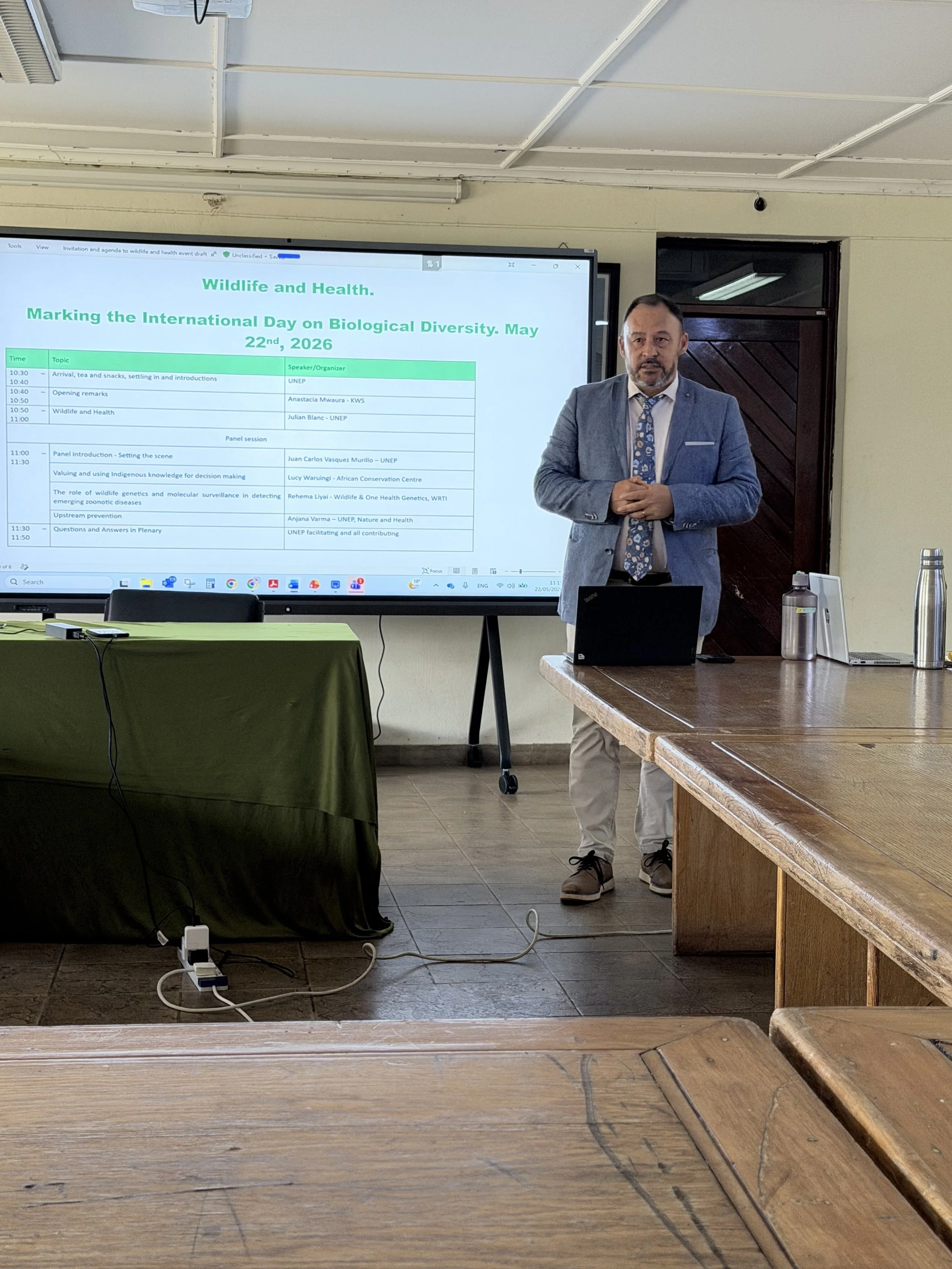
Juan Carlos Vasquez Murillo of UNEP opening the panel session.
Juan Carlos Vasquez Murillo of UNEP introduced the panel that would follow, framing three threads the speakers would explore in turn: the role of indigenous knowledge in shaping locally-led decisions; the contribution of science and surveillance in detecting emerging risks; and the architecture of upstream prevention, what it takes to stop a spillover before it begins.
Indigenous knowledge, in practice

Lucy Waruingi, Executive Director of the African Conservation Centre, speaking on Indigenous knowledge and decision-making.
For Lucy Waruingi, Executive Director of the African Conservation Centre (ACC), the answer to that first thread is rooted in three decades of patient grassroots work. She spoke about ACC's role in establishing several of Kenya's most influential community-led conservation institutions; among them, the South Rift Association of Land Owners (SORALO), the Twala Tenebo Women's Resource Centre in Laikipia, and the Amboseli Ecosystem Trust (AET), institutions that have placed decision-making power closer to the communities living alongside wildlife.
What stood out, she told the room, was what these institutions have made possible:
“The compatibility between wildlife and mobile pastoralism has maintained open space and seasonal migrations, both important for sustaining coexistence. But the future viability of the populations depends on large home ranges and connectivity between otherwise isolated park populations.”
In other words, the wildlife and the pastoralists are not competitors; they have shared this land for centuries. The risk is not their coexistence but its erosion, by fragmentation, by lost connectivity, by the slow squeeze on the open landscapes that have made coexistence possible in the first place.
A Maasai proverb she shared captured the philosophy underneath the work: “The livestock and the land are our life.”
Detecting the next risk
Rehema Liyai of the Wildlife & One Health Genetics laboratory at the Wildlife Research and Training Institute (WRTI) followed, turning the conversation into the role of wildlife genetics and molecular surveillance in detecting emerging zoonotic diseases.
Her closing message reframed the science as a public-good intervention. Protecting biodiversity, she emphasised, also protects human health, the founding insight of the One Health approach. Molecular surveillance is essential for preparedness and prevention. Early detection can stop a future pandemic before it begins. And One Health is not a peripheral concept but a foundation for sustainable conservation.
Upstream prevention: a different starting point

Anjana Varma, who leads UNEP's Nature for Health (N4H) initiative, speaking on upstream prevention.
The final intervention came from Anjana Varma, who leads the UNEP's Nature for Health (N4H) initiative. She opened by mapping the prevention landscape itself, a continuum with three distinct levels. Upstream prevention acts before risk emerges, addressing the environmental, structural and systemic drivers of disease emergence: land-use policy, habitat preservation and restoration, wildlife health, One Health coordination, regulation of the wildlife trade, water and rangeland management, and the empowerment of Indigenous Peoples and local communities. Spillover prevention acts at the point of transmission by managing the wildlife-human interface to reduce contact and by conducting surveillance across animal populations. Downstream prevention acts after risk has emerged, encompassing epidemic surveillance, human vaccination and reactive outbreak response to address symptoms once a pathogen is already circulating.
These levels form a continuum with overlapping interventions, she emphasised, but the bulk of global pandemic resources continues to flow to the downstream end, after the cascade has already begun.
N4H exists to shift the response upstream. Rather than waiting for the next outbreak and racing to contain it, the initiative supports countries to prevent spillover at its source, across three interconnected domains: nature, people and governance. Healthy ecosystems reduce contact between wildlife, livestock, and people. Empowered communities steward those ecosystems and detect early warnings. Cross-sectoral governance turns isolated efforts into a coherent system.
Kenya is one of six N4H Phase I countries leading this work, alongside Ecuador, Ghana, Mongolia, Rwanda and Vietnam. The N4H initiative has also entered Phase II, with implementation beginning across new jurisdictions, Angola, Bhutan, Madagascar, the State of Campeche (Mexico), Uzbekistan, and 26 Pacific Island countries and territories through SPREP.
For Anjana, this is what acting locally for global impact looks like when applied to pandemic risk: country-led stewardship of ecosystems, strengthened One Health coordination, and locally led action that, taken together, constitute the architecture of global pandemic prevention.
Plenary discussion
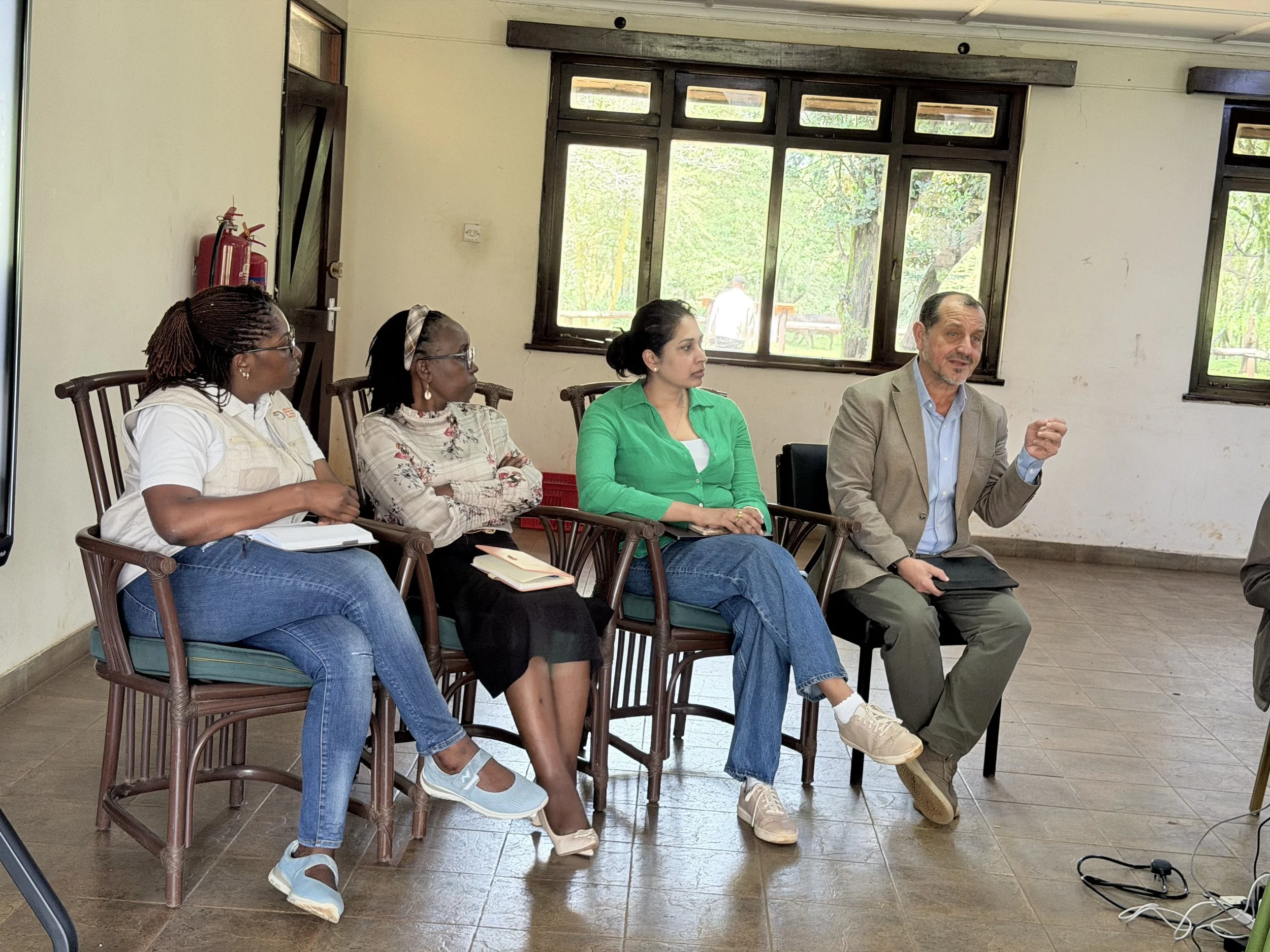
Panellists during the plenary Q&A session.
The session closed with a plenary discussion that drew threads across the morning's four interventions and the room. Questions explored how Indigenous knowledge gets translated into national policy, how zoonotic spillover happens, and how we can prevent it, what cross-ministerial coordination requires in practice, how upstream prevention is financed, and where the partnerships convened in Nairobi can take this agenda next.
A photograph, and a commitment
Participants at the Nairobi Safari Walk after the marking of the International Day for Biological Diversity 2026.
The event ended with a group photograph under the trees, a visual reminder that the people who do this work do it together: across ministries, across mandates, across scientific and traditional knowledge systems.
The conversation in Nairobi was modest in scale and ambitious in premise. What Kenya does, in its rangelands, its research institutes, its conservancies and its policy rooms, has consequences far beyond Kenya. That is what the day's theme means in practice: acting locally, for global impact. And it is the work N4H exists to support.