Ghana
Pen, Paper, and the Next Outbreak: Ghana's Nature4Health Story
Ghana was among the first countries selected for Nature4Health, a multi-partner effort to prevent disease spillover from animals to people. In four regions, the team brought together farmers, hunters, veterinarians, and ministries to show how their expertise can reduce the risk of the next spillover.
When Mr Baffour Ahmed Haruna arrived at the Nature4Health workshop in Tarkwa, he expected to stay only long enough to deliver his opening remarks. Instead, the Municipal Coordinating Director sat down and stayed for the entire day.
Around him, farmers, veterinarians, forestry officers, traders and local government representatives worked side by side, bent over large sheets of paper, sketching their own communities, the forest edge, the animals they lived alongside, and the paths a disease might take from one to another. The scene made it clear how the workshop was unfolding.
"He said this is so key to him; he's not going back," recalls Prof. Richard Suu-Ire, who was in the room. For Robin Breen, watching from the side, it was the moment the process seemed to land: "That was one of the times when I was like, okay, it seems to be resonating with people."
Moments like that came to define Ghana's Nature4Health scoping process, showing that the knowledge needed to prevent the next disease outbreak already existed within communities. From there, the process shifted to creating space for that knowledge to be heard and applied.
The decision not to decide
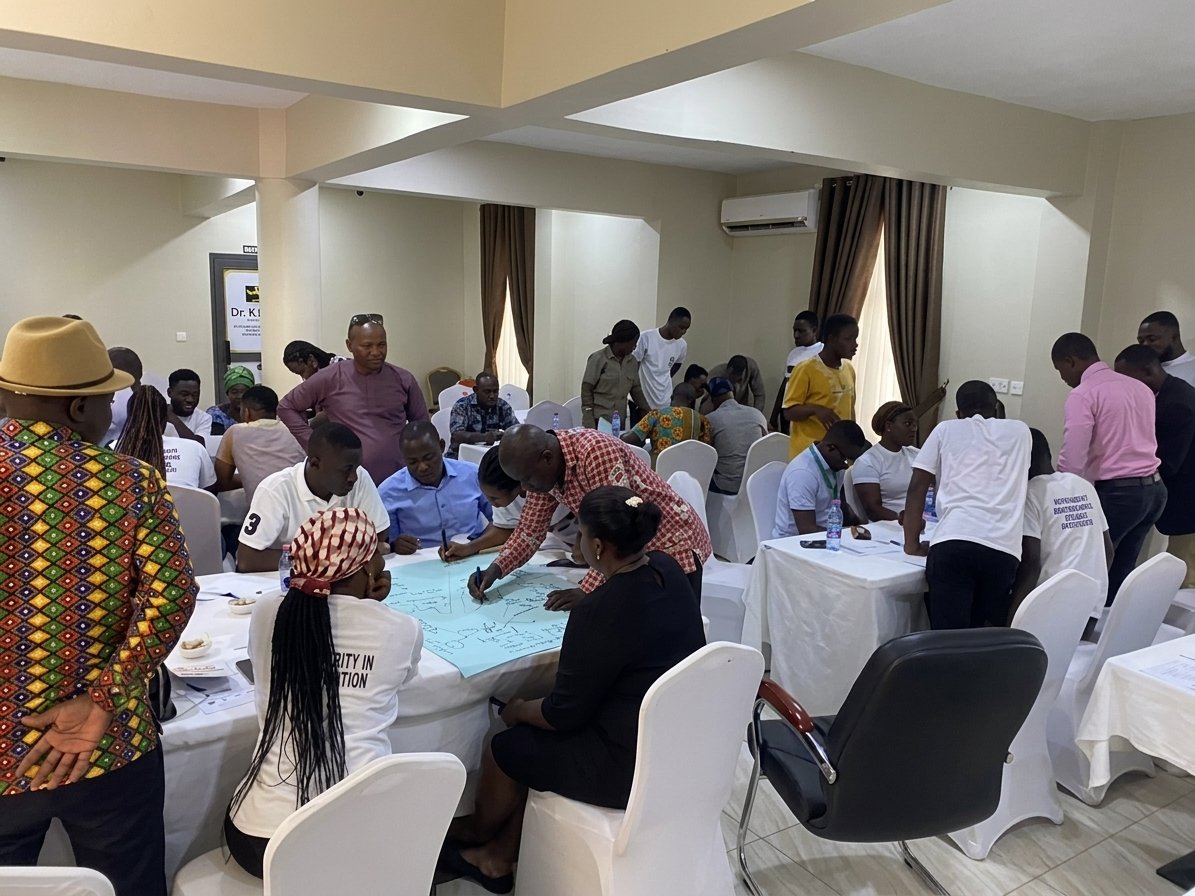
Rich picturing in Tarkwa, Western Region of Ghana
The exercise is called rich picturing. Participants are given markers and large sheets of paper and asked to draw the places they know best, mapping where people, animals and the environment meet and where the risk of disease might emerge. This simple exercise became a powerful way to surface local knowledge and trace the pathways by which a disease can spill over from animals to people.
Rich picturing was one part of Nature4Health's scoping process, conducted across Ghana in the first half of 2024, covering four ecologically distinct regions: Kumasi in the middle belt; the savannah around Mole National Park in the north; the forest and mining country of the Western Region; and Accra on the coast, home to the country's national ministries. Each region provided a different setting for the same process.
The purpose behind it is more complex than the markers suggest. Ghana has six priority zoonotic diseases, including anthrax, avian influenza, and the haemorrhagic fevers Marburg and Lassa. In 2022, the country confirmed its first outbreak of Marburg virus disease. These illnesses arise where people, animals, and a changing environment intersect, which is why the workshop focused on that area.
Nature4Health – a multi-partner trust fund hosted by a Secretariat within UNEP – is built on the premise of reducing health risks by addressing anthropogenic environmental stressors. Following the COVID-19 pandemic and subsequent calls to focus on ‘upstream’ or prevention-at-source measures, the German government provided 50 million euros in seed funding to Nature4Health.
With growing evidence that prevention measures are cheaper than responding to pandemics, and with expertise from intergovernmental and civil society organisations, including the Secretariat of the Convention on Biological Diversity, the United Nations Development Programme (UNDP), UNEP, the World Health Organization (WHO), the World Organisation for Animal Health (WOAH), and the International Union for Conservation of Nature (IUCN), the fund aims to reach 18 countries across three staggered phases.
Prof. Suu-Ire, a veterinary scientist at the University of Ghana, has spent years on upstream prevention. Mr Breen, who joined the project, initially provided close support to the Ghanaian team for EcoHealth Alliance before UNDP and IUCN became the lead Nature4Health partners. Their account of what made the scoping work, in the end, is a single idea told two ways: prevention cannot be handed to people but has to be built with them.
The four-region approach was not the initial plan. The decision emerged only as the process unfolded.
“That wasn't the original plan to have four regions,” he says. He and the University of Ghana team arrived at the first meeting in Accra with proposals but no decisions. “We had ideas, but we didn't make any decisions, and it was really up to the core team.” As the discussion continued, the map took shape in the room. Someone pointed out that if the project was serious about covering the country's diverse diseases and ecological zones, it could not remain in the capital. “We're not going to get the lived experiences from the central ministries,” Breen recalls the argument. “We need to go to the local governments and the places where people and animals interact daily.”
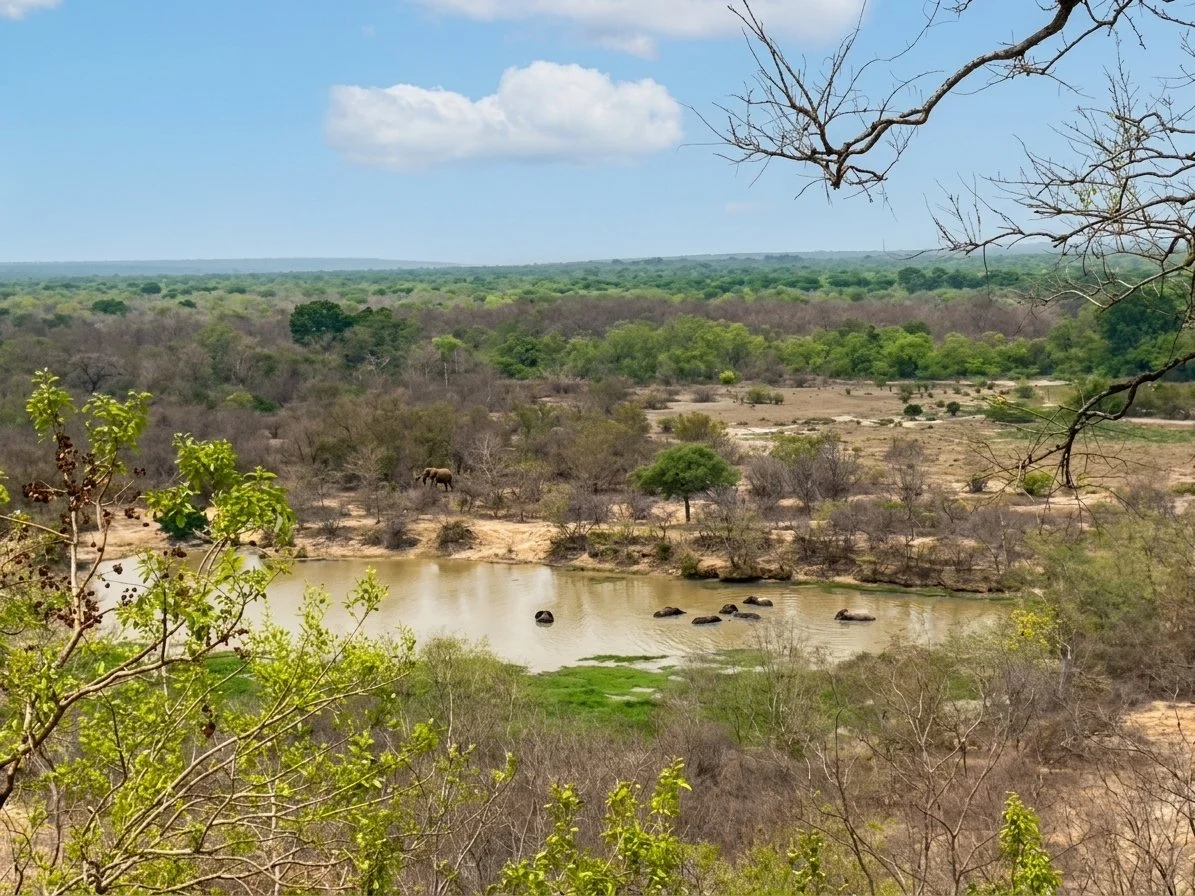
Elephants bathing at the pool site, Mole National Park - the savannah zone anchored in the northern sector.
For Prof. Suu-Ire, collective ownership was the method, not a nicety. “We insisted on teamwork,” he says. “All the members were involved, and we communicated the next steps to everybody, so that people were in tune with what was going to happen. It's a team where we all decided.” The zones followed the country's own contours: the northern sector anchored on Mole, the middle zone on Kumasi, the forest and mining zone in the west, and Accra kept for last, deliberately, so that “the big directors” could be brought in to close the process where government sits.
Breen's own role, as he told it, was mostly to hold back. The most important thing the global partner did was to decline to make the decisions itself. “Giving the decision-making power to the core team to make that decision collectively, I think, was the most important part.”
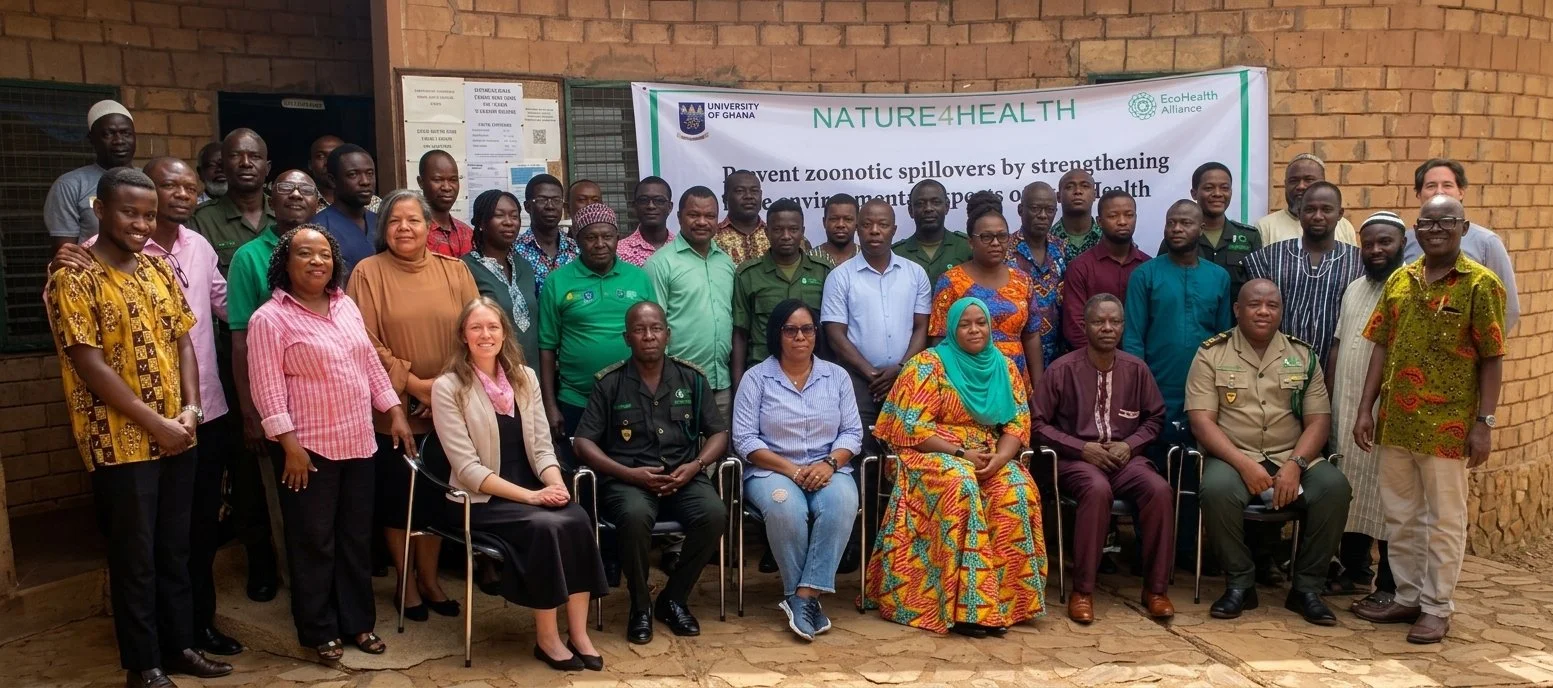
Workshop in session at Mole
The overlap nobody had named
One key insight from the cross-sector approach emerged late, in Accra. The final workshop revealed what many in the room had not seen before. There, the workshop shifted from shared mapping to an unexpected discovery.
Ghana's environmental work is split across more than one government body: the Ministry of Environment, Science, Technology and Innovation (MESTI); the Environmental Protection Agency; and, in places, local government. In the final workshop, people who did not work in the environmental sector discovered this in real time.“Oh, okay, there are different branches of the environment that all do related things,” Breen says. What the discussion revealed was not conflict so much as blind spots: we didn't know you were doing this; we do this. Suu-Ire, who collaborates with those same bodies through Ghana's One Health platform, frames it as a balancing act rather than a turf war. “They look like different authorities, but each one is very important to a particular area. We don't want to drop any of them. They have diverse interests.”
Why ministries showed up and stayed
Getting MESTI, the Ministry of Food and Agriculture, the Ministry of Health, the Forestry Commission and the national disaster-management body genuinely engaged in the same process is rare, and both Suu-Ire and Breen were asked how it was achieved. Their answer lay in the steps that brought them there.
Breen's answer was brief: relationships. “The short answer is that it's because Suu-Ire has worked hard to maintain strong relationships with people.” He added that it helped that the convener was a university rather than a ministry, which could approach the others “from a more neutral standpoint.”
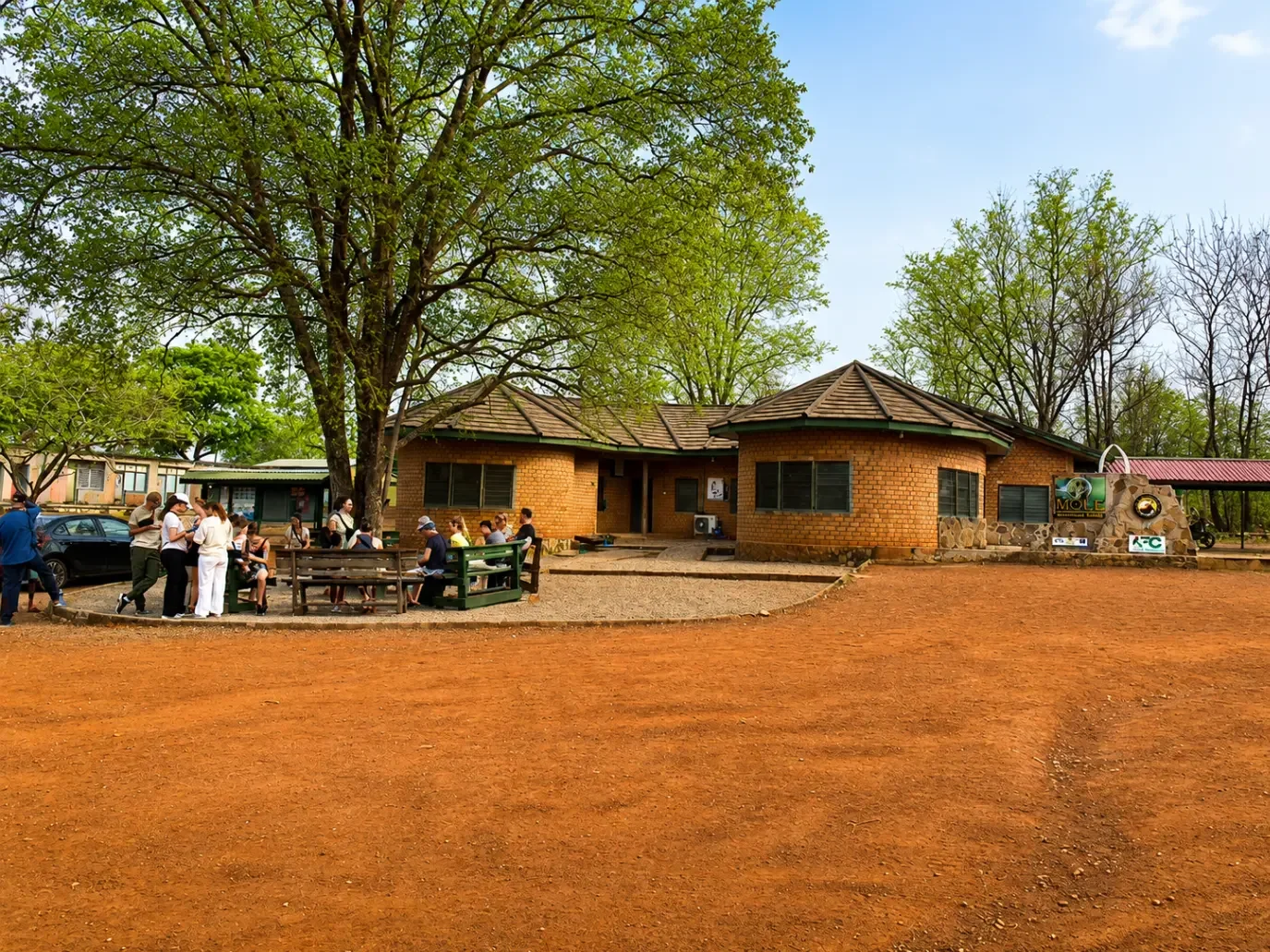
The conference hall at Mole, where participants from across the northern regions gathered.
Prof Suu-Ire's own answer was fairness and formality. “The approach that made me very strong is that I'm being fair to all of them.” He insisted on going through official channels, including letters to directors and written nominations, precisely so that those who turned up would own their place in the room. “We don't just go and call friends. Even if we know somebody influential, we make sure it's officially documented.”
He tells a brief story to make the point. At the Accra workshop, the Director of Public Health attended in person and ensured the department was represented. His presence mattered. The representative later became one of Suu-Ire's most steadfast and closest collaborators; "Today I still work with him," he says. The lesson he draws is unglamorous and specific: when the head of an area shows up in person, "they see that it is serious business," and the room follows.
What the people already knew
Ask Prof. Suu-Ire what upstream prevention looks like when you start with people. He does not reach for a framework. He starts with what he has seen.
“When we went out there, we realised that the people knew what prevention is all about,” he says. “That is the knowledge we draw on. The locals themselves know. We only need to mobilise and gather information from them. You don't go and tell people, ‘This is what you are supposed to do.’ The people tell you where they are. It is their knowledge.” For him, prevention is “taking preventive measures from the source and then moving up to the control.”

A mother, her baby on her back, presents her group’s rich picture.
Breen sheds light differently. What people lack, he says, is not understanding; it is vocabulary. “People know, but they don't know technical jargon. They're familiar with the fact that if you make changes to the land, there'll be changes to the wildlife around them, or to their livestock. But they don't necessarily know ‘land-use change as a driver of zoonotic disease.’ That doesn't click.” And it doesn't need to. “You don't need the technical lens to know that if you change the environment, you change the way animals and humans meet.”
That is the quiet argument beneath the markers, the letters, and the four-region map: the expertise most needed in the process was already in the room, held by people who had never been asked for it in these terms.
What comes next
The scoping is complete; the implementation plan has been written, a blueprint shaped activity by activity by the people who will carry it out.
Prof. Suu-Ire says the officials and community members who filled those rooms still reach out to ask what happens next. "They are still asking: Nature4Health was so nice. What are we doing? What are the next steps?" Now that the funds have been released, the team has their work cut out for them.
According to Ghana's account, prevention was never something handed down to communities; it was something built with them.
N4H Ghana addresses upstream drivers of zoonotic spillover through a One Health approach.
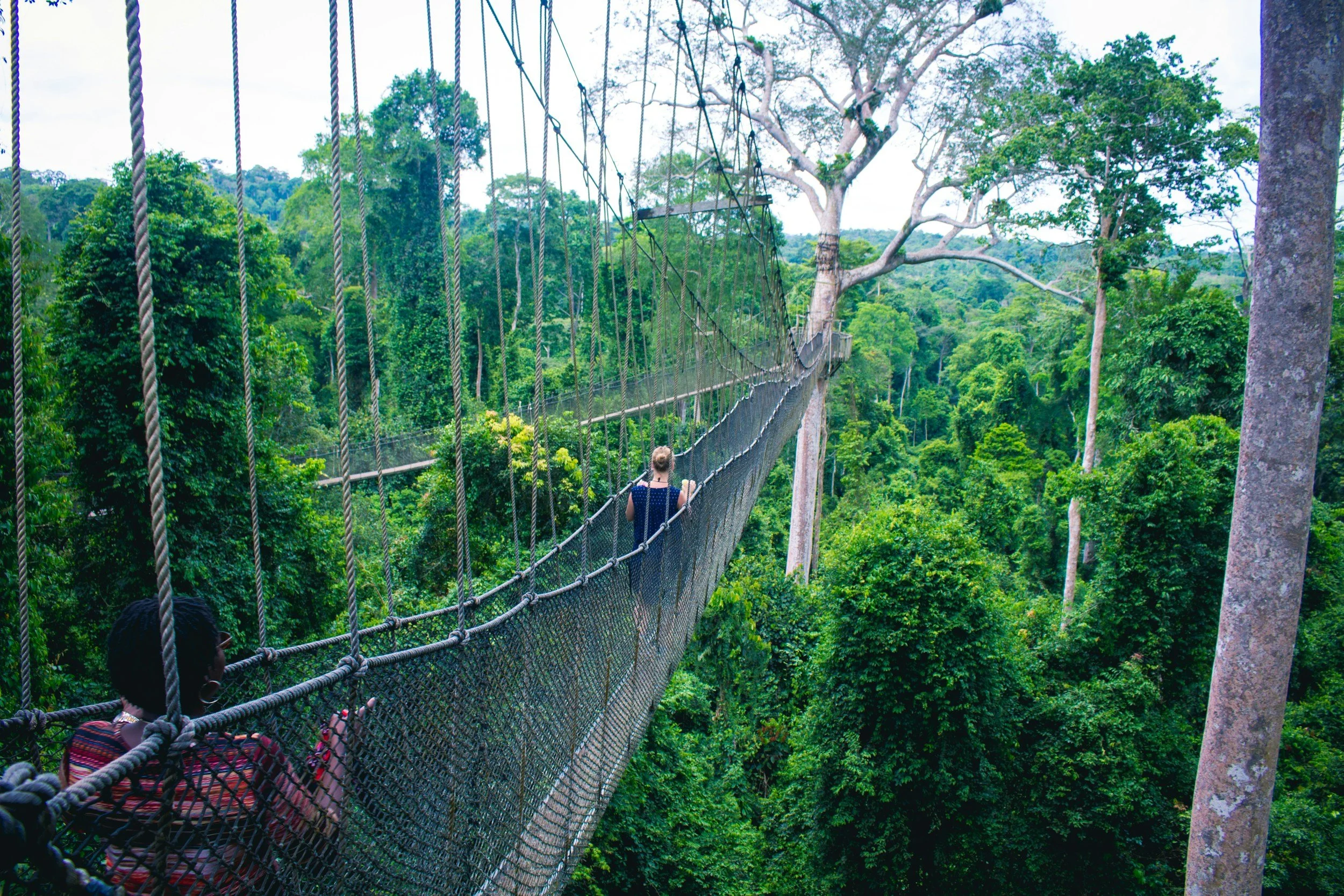
Ghana is a hotspot for zoonotic diseases with many endemic and emerging pathogens being reported in livestock, wildlife, and humans, including Marburg virus, Lassa fever, Rabies, Anthrax, Brucellosis, and other zoonotic microorganisms. Avian influenza is fast becoming endemic causing huge financial loss to the poultry industry. Human activities, compounded by natural events have put Ghana’s biodiversity under serious threat. Recent changes in land use and agricultural production systems, natural resource extraction (e.g., wildlife and rosewood harvest, mining, timber logging) and an expansion of livestock production into wildlife habitats is altering ecosystems and likely increasing the risk of zoonotic spillover. While Ghana contributes relatively little to climate change, several climate shocks threaten the country, including rising temperatures, less predictable rainfall, drought, and flooding which are expected to influence the distribution and patterns of infectious diseases as well as human and animal movement.
Aligned with the global objectives of N4H, Nature for Health Ghana works with human, animal, and environmental health experts, policy makers, and other stakeholders to co-develop integrated and coordinated policies, generate and disseminate evidence on links between biodiversity, climate and health, and support decision makers and other key actors to take preventive measures. N4H Ghana is led by a multi-sector Core Team of representatives from the University of Ghana, Wildlife Division of Forestry Commission, Veterinary Services Directorate, Ministry of Environment, Science, Technology and Innovation, National Disaster Management Organisation, and Public Health Directorate of Ghana Health Service with support from EcoHealth Alliance as the global convening partner.
Following Ghana’s expression of interest and selection as a N4H phase one country, the N4H Ghana team conducted a systemic inquiry between January – June 2024 across four regions of Ghana to understand zoonotic spillover risks, and their drivers. The scoping process also identified concrete ‘upstream’ or primary prevention interventions to tackle root causes of disease emergence at the environment-health interface. Findings from the systemic inquiry have been developed into a 3-year Implementation Project Document (IPD) outlining how N4H Ghana will reduce spillover risk by employing preventative One Health approaches aligned with local and national priorities. The IPD will address five key areas of
awareness creation, sensitisation and advocacy,
surveillance and risk assessment,
risk reduction policies and guidelines,
One Health coordination and information sharing, and
monitoring, evaluation, learning, and outreach.
Collectively, these areas of work will generate and disseminate evidence on the links among biodiversity, climate, and health and support decision-makers and other stakeholders to take preventative measures for disease risk reduction that mutually support the protection of biodiversity.
Convening Partner
-
The United Nations Development Programme (UNDP) advances the idea that sustainable development succeeds when governance, climate resilience, and human well-being are strengthened together as interconnected pillars of national progress.
Founded in 1965, UNDP is the UN’s global development agency, supporting countries to reduce poverty, build strong institutions, and manage environmental and health risks. Bringing together experts in governance, climate adaptation, and health systems, UNDP helps governments turn evidence-based policies into effective action.
In Ghana, UNDP has been selected as the implementing partner for Phase II, supporting the integration of One Health principles into national planning, strengthening resilience at community and institutional levels, and building the capacities needed to anticipate and manage emerging threats.

-
The International Union for Conservation of Nature (IUCN) recognizes that healthy ecosystems are vital for human health, reducing environmental risks, and supporting sustainable development.
Founded in 1948, IUCN is the world’s largest environmental network, bringing together governments, experts, and civil society to advance evidence-based conservation and strengthen environmental governance. With expertise in biodiversity, ecosystem management, and nature-based solutions, IUCN helps countries integrate ecological science into policy and practice.
In Ghana, IUCN serves as a convening partner for Phase II of Nature for Health, fostering collaboration across sectors and ensuring ecosystem health remains central to the country’s One Health efforts.
Country Partners

-
University of Ghana (UG) is a leading university, research institute, and learning centre in Ghana. Nature for Health is coordinated locally by The School of Veterinary Medicine in collaboration with Ghanaian government and NGO partners.
-
Ministry of Environment, Science, Technology and Innovation (MESTI) formulates policies and accelerates social development through appropriate environmentally friendly scientific and technological practices and techniques.
-
Veterinary Services Directorate (VSD) of the Ministry of Food and Agriculture ensures the health of animals and enhances productivity through the provision of quality animal health care and veterinary services. It supports public health by controlling animal and zoonotic diseases.
-
National Disaster Management Organisation (NADMO) promotes disaster risk reduction and climate change risk management through awareness creation and post emergency assistance. NADMO is the chair of Ghana’s National One Health Coordination Body.
-
Wildlife Division of Forestry Commission (FC) is responsible for conserving all wildlife in Ghana and sustainably managing protected areas and wildlife sanctuaries for the socioeconomic benefit of all.
-
Public Health Directorate of Ghana Health Service (GHS) leads the development and implementation of policies and strategic plans and programmes that protect, promote and improve public health, including disease prevention, detection, and control.
Latest
-

Savannah Zone regional scoping workshop
-

Western Region scoping workshop
-

Greater Accra Region scoping workshop